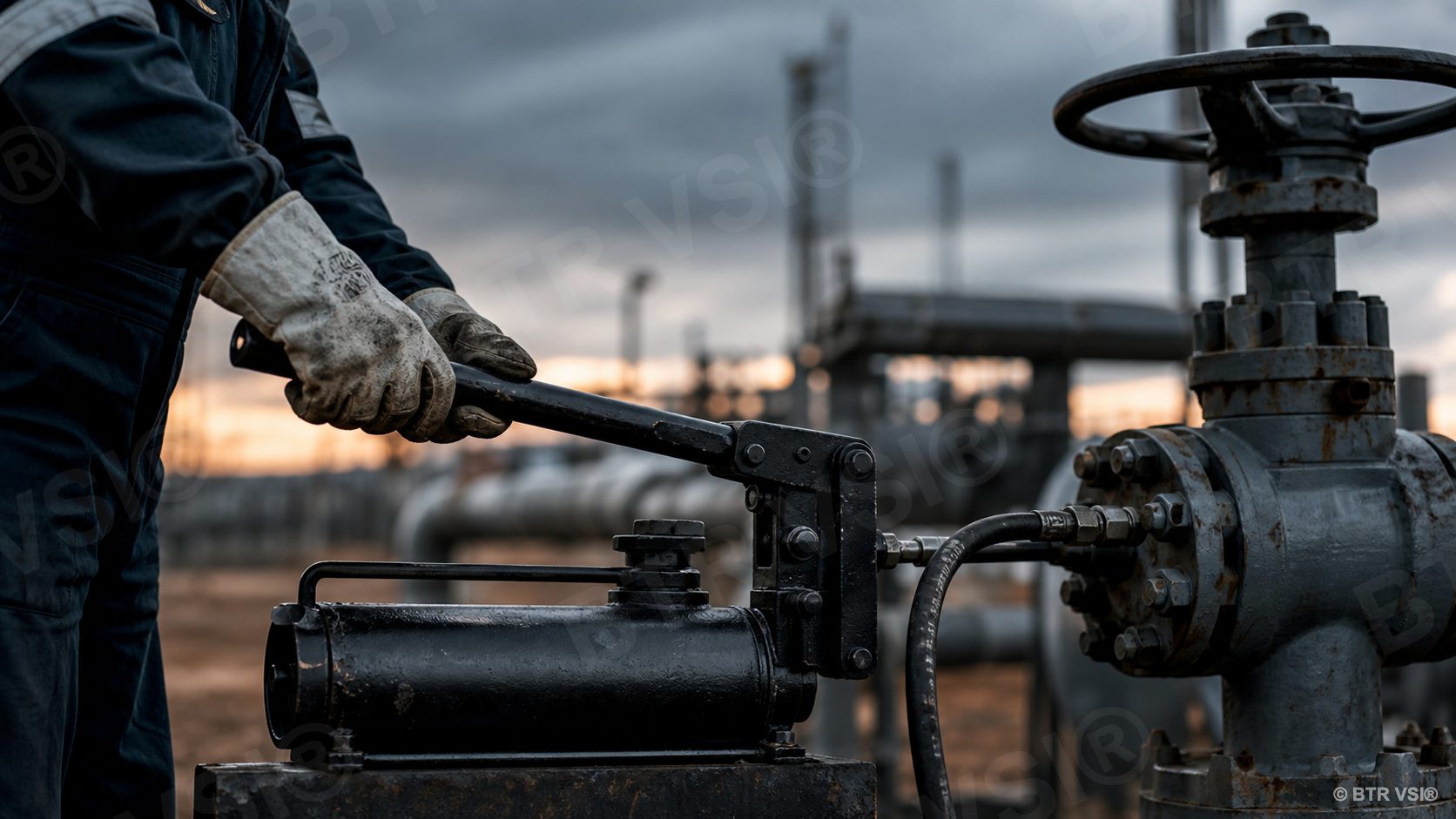
A hydraulic hand gun uses a hand-operated pump to pressurise hydraulic fluid behind a piston. The piston drives a sealant stick, or fluid sealant, through a hose and coupling into the valve fitting. Slow strokes multiplied by piston area produce injection pressure far above what the hand alone could apply, without any power source.
Knowledge · Injection equipment
The hydraulic hand gun explained: how a BTR450D-class gun works
A hand pump, a hydraulic piston and a sealant stick combine to inject through fittings on live valves.
1. The principle: force multiplied
The hand gun is a simple hydraulic amplifier operated by hand. Your arm supplies force at the pump handle during every stroke. A small pump piston converts that effort into fluid pressure.
Confined fluid carries the pressure to a larger piston in the sealant cylinder. The same pressure acting over a larger area produces much greater force. The gun therefore turns steady hand effort into injection pressure far beyond raw grip.
The exchange is speed for force, and that shapes the whole tool. Each stroke displaces only a small volume of sealant. A gauge on the hydraulic side shows the pressure you actually apply.
Injection is slow, controlled and easy to stop, which suits live-valve maintenance.
2. Main parts of the gun
Most hydraulic hand guns share a short list of parts. The BTR450D is one example of the class. Once you know the parts, any maker's gun becomes readable.
- Pump handle and pump piston: the small piston your arm drives, which sets the fluid pressure.
- Hydraulic fluid chamber: the confined fluid that carries pressure to the working piston.
- Working piston: the larger piston that pushes directly on the sealant.
- Sealant cylinder: the tube that holds a sealant stick or a fluid charge.
- Hose and gauge: the high pressure hose, plus the gauge that shows applied pressure.
- Coupling and check valve: the connection to the buttonhead fitting that holds pressure between strokes.
The check valve is what makes careful hand work possible. It lets you pause, read the gauge and decide before the next stroke.
3. What happens during an injection
Before the first stroke of the handle, three gates apply. The valve must have injection fittings in good condition, and its design must suit injection. Site rules and the permit-to-work must allow the job, with OEM documents consulted where they exist.
The injection itself then becomes one repeated loop of steps:
- Connect the coupling to the buttonhead fitting and purge air from the line.
- Pump steadily and watch the gauge, not the valve alone.
- Read the pressure response as screening evidence; it suggests whether sealant is moving.
- Stop at the planned amount, or when pressure climbs sharply without movement.
Rising pressure that settles again suggests sealant moving into the seat area. A fast climb with no movement suggests a blockage or a closed check valve. Deliver controlled amounts within the ratings of equipment and fitting.
Industry safety practice limits stem-side injection through buttonhead fittings to 3,000 psi. Our page on high pressure gun safety rules covers the rest.
4. When a hand gun is enough
A hand gun is often the right tool for small, careful work. It suits top-up doses of lubricant, single-fitting sealant jobs and sites without power or air. Field teams often keep one as a backup even when pumps are available.
It is not enough when the job needs volume or sustained pressure. Large ball valves can take a surprisingly large quantity of sealant. Many fittings in one campaign also make hand pumping slow and tiring.
Cold weather can stiffen some sealants and raise the effort per stroke.
For heavy jobs, an air-operated injection gun or a pneumatic pump system fits better. Our BTR 550D air-operated gun is rated to 10,000 PSI at a 100:1 ratio. Match the tool to the valve population you actually maintain.
5. Care, honest limits and choosing
A hand gun cannot solve every valve problem on its own. If a valve is seized solid or the seat is damaged, injection may not help. In those cases the honest next step is a proper assessment or repair.
A valve that seems better after injection is also not proven sealed. Pressure behaviour is screening evidence, and the confirming test is a seat-leak test under agreed conditions. One example is pressure decay measured across the closed valve.
Regular care keeps a hand gun dependable through many seasons of work. Clean the coupling after use, verify the gauge and service the seals on schedule.
Our page on keeping sealant guns reliable covers the routine. Two service kits exist per gun model, one minor and one major.
If you are buying, start with our injection equipment buying guide. Before you enquire, gather the details that shape the choice. Our page on what to tell us before an equipment enquiry lists them.
Common questions
Hand gun basics questions, answered directly
How does a hydraulic sealant gun work?
A hand pump pressurises hydraulic fluid behind a small piston. That pressure acts on a larger piston, which pushes sealant through a hose into the valve fitting. Each stroke delivers a small, controlled volume at high pressure.
What is a sealant stick?
A sealant stick is the maintenance product itself, cast in solid stick form. You load it into the gun cylinder, and the piston pushes it forward under pressure. Sticks are clean to handle and suit small jobs.
When should I choose an air-operated gun instead?
Choose air power when the job needs volume, many fittings or sustained pressure. Cold conditions that stiffen sealants also favour powered delivery. A hand gun still suits small doses, remote sites and fine control.
Is hand injection safe on a live valve?
It can be, within the ratings of the gun, hose and fitting, under a permit. Training matters, because the operator controls every stroke. Watch the gauge and stop when the response looks wrong.
Choosing a sealant gun?
Send the valve and fitting details. An engineer replies within 24 hours.
Include valve size and class, the service, fitting types and what the valve is doing now.