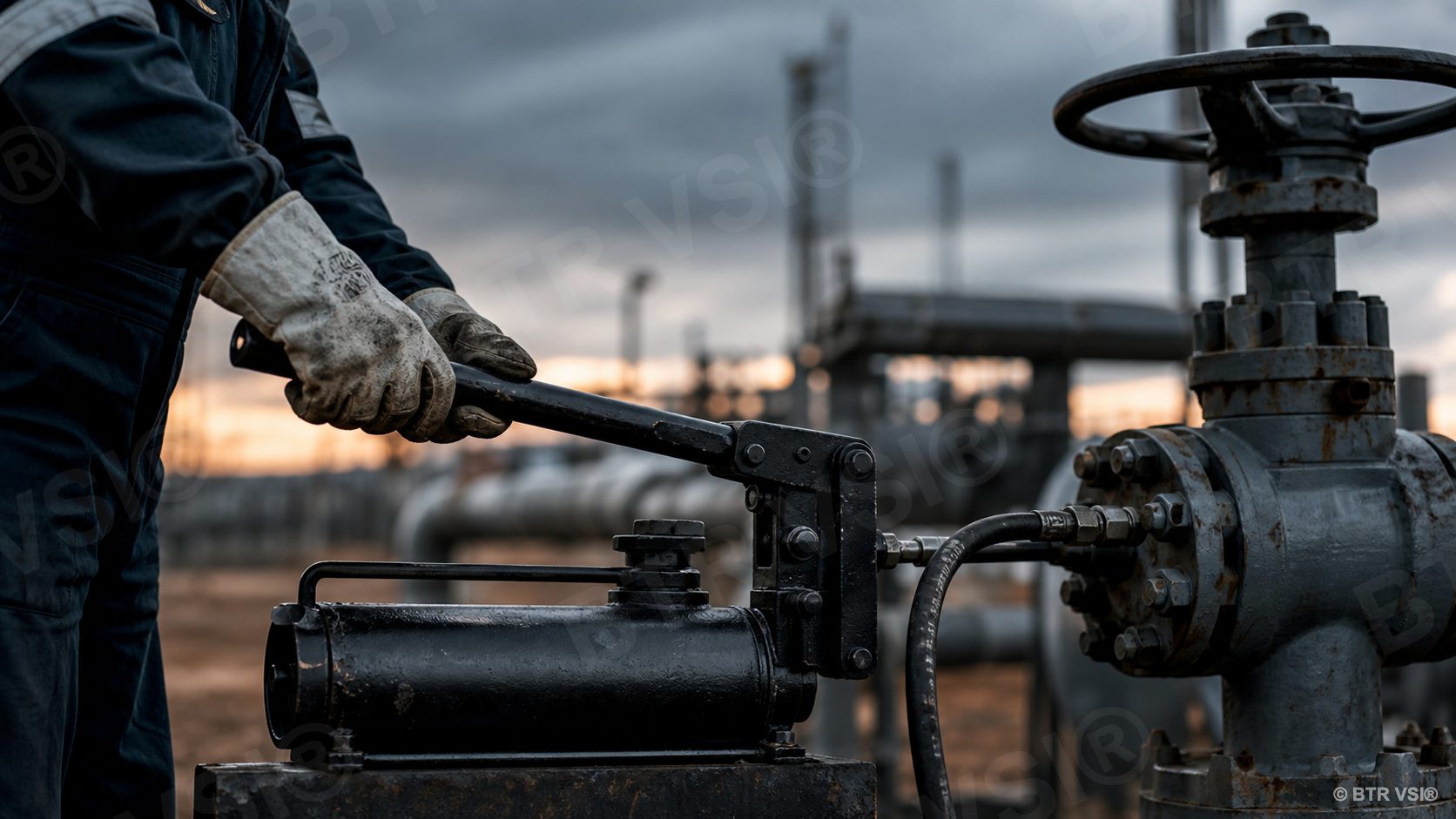
An air operated sealant gun uses compressed air to drive a small hydraulic piston, which pushes sealant through a handpiece into the valve fitting. The ratio multiplies drive air pressure: on the BTR 550D, a 100:1 ratio produces up to 10,000 PSI. A double-acting piston delivers on both strokes, so large or repeated injections take less time than with a hand gun, provided the site has suitable air supply.
Knowledge · Injection equipment
Air-operated injection guns: ratio, double-acting pistons and delivery
Compressed air supplies the force, so the operator sets the pace and watches the pressure.
1. How an air-operated gun works
An air-operated sealant gun is a pneumatic-to-hydraulic amplifier at heart. Compressed air drives a large air piston, which pushes a much smaller hydraulic piston. That small piston forces sealant through a hose to the handpiece, which couples to the buttonhead fitting on the valve.
The ratio comes from the difference in piston areas. On the BTR 550D the ratio is 100:1. Outlet pressure is about one hundred times drive air pressure. When sealant pressure balances that force, the gun stalls and holds.
The operator regulates air pressure at the inlet, never sealant pressure directly. The gun then holds pressure without pumping effort from the arm. This idea anchors the injection equipment buying guide: match the drive to the site.
2. What a double-acting piston changes
A single-acting piston delivers on the power stroke only, then draws fresh sealant on the return. A double-acting piston, as fitted to the BTR 550D, delivers in both directions. Flow at the valve is steadier, with shorter pauses between strokes.
The difference shows most clearly in repeated work and larger volumes. Filling several fittings, or moving a larger charge into one valve, takes less waiting. The operator keeps a steady rhythm instead of pausing while the chamber refills.
There are trade-offs worth naming before you choose. A double-acting piston needs seals that work in both directions, so service kits carry more parts. It also uses more compressed air for the same delivered volume. For volume-driven work, a pneumatic pump with a stroke counter gives accountable delivery. It counts what was injected, which a gun cannot do unaided.
3. What the pressure rating really means
The ratio multiplies whatever air pressure you admit at the regulator. It does not by itself promise any fixed outlet pressure. Sealant viscosity, hose length and cold weather all change what reaches the fitting. Where OEM documentation exists, consult it for the valve's own limits.
Ratings form a chain, and the weakest link governs the job. A gun rated to 10,000 PSI does not make high pressure safe everywhere. One industry safety practice limits stem buttonhead fittings to 3,000 psi, and site rules may be stricter still.
Watch the pressure response rather than chasing a number. A steady rise with movement suggests normal filling; a fast rise with no movement suggests a blockage. Stop and investigate, because the common causes are covered in sealant injection with no uptake.
4. Air gun, hand gun or pump
An air gun earns its place where injections are frequent or volumes are large. Crews treat more valves per shift with less arm fatigue. For occasional small jobs, a hydraulic hand gun is simpler and needs no air supply.
Be equally clear about what this gun cannot do for you. It cannot run without compressed air of adequate volume and cleanliness. At 63 lbs shipping weight, it is not a one-hand tool for a single fitting. No gun repairs mechanical damage; a worn bearing or scored seat needs assessment, not injection.
Before any injection, check the gates that apply to every job:
- Injection fittings are present and in good condition.
- The valve design and the service suit injection.
- Site rules and the permit-to-work allow the job.
- OEM documentation, where it exists, has been consulted for limits and warranty terms.
Injection is not universally possible, and saying so early saves wasted trips. For the fuller comparison, read choosing injection equipment by pressure, volume and field constraints. The BTR 550D air-operated gun page carries the working specification.
5. Keeping an air gun healthy
Air quality decides seal life more than hours of use. Water and grit score the cylinder wall and destroy piston seals quickly. Fit a filter and water trap, drain them often, and feed the gun clean, dry air.
Plan for wear before it stops the crew. Abrasive and filled sealants are hard on piston seals over time. Keep the minor service kit on the shelf, and schedule the major kit by condition. Our equipment repair service also rebuilds guns sent in.
After any treatment, close the loop with proper evidence. Easier handwheel action suggests progress but does not prove seating. The confirming step is a seat-leak test under agreed conditions. Pressure decay across the closed valve, with double block and bleed, is one usual form.
Common questions
Air gun basics questions, answered directly
What does a 100:1 ratio mean on an air operated sealant gun?
It means outlet pressure is about one hundred times the drive air pressure. The exact figure depends on your air supply, sealant viscosity and hose losses. The ratio is multiplication, not a fixed output.
Do I need an air operated gun or a hand gun?
Choose air when injections are frequent, volumes are larger or crews treat many valves per shift. Choose a hand gun for occasional small jobs or sites without compressed air. Reliable air supply on site is the deciding gate.
Can an air operated gun overpressure a valve fitting?
Yes, if pressure exceeds the lowest rating in the chain. A gun rated to 10,000 PSI can overpressure a fitting rated far lower. Follow the fitting and valve ratings, watch the pressure response, and stop when pressure climbs without movement.
What maintenance does an air operated gun need?
Clean dry air, a drained water trap, and piston seals replaced by condition. Keep the minor service kit available and schedule the major kit before performance drops. Wipe sealant from the handpiece after every use.
Choosing an air operated gun?
Send the valve details. An engineer replies within 24 hours.
Include valve sizes and counts, seat leak or stem leak symptoms, and the compressed air available on site.